

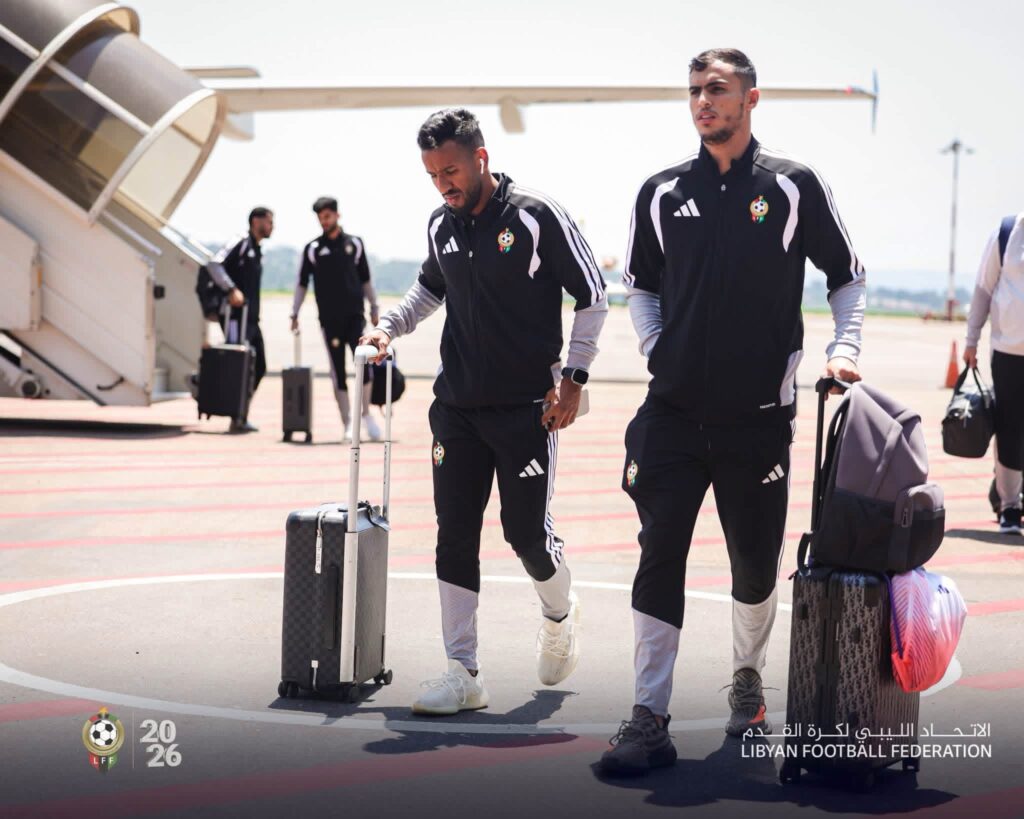
Kabalega International Airport in Hoima took a significant step towards its expected role at the 2027 Africa Cup of Nations on Sunday when Libya became the first visiting national football team to arrive through the new facility.
The Libyan delegation flew into Hoima ahead of Tuesday’s AFCON 2027 qualifier against Uganda Cranes at Hoima City Stadium, giving the airport its first major football-related operational test.
Their arrival was followed by plans to fly the Uganda Cranes from Entebbe to Hoima, effectively testing the air connection that government expects to use for teams, officials and other tournament stakeholders when Uganda co-hosts AFCON next year.
Libya eventually touched down at about 1:00pm after an earlier attempt was disrupted by poor weather, forcing the aircraft to return to Entebbe before another flight was made to Hoima.
The delegation was received by officials including Minister of State for Transport Fred Byamukama, representatives of the Uganda Civil Aviation Authority and members of the AFCON 2027 Local Organising Committee.
For Uganda, the operation provided an opportunity to test more than the football facilities ahead of Tuesday’s game.
Hoima City Stadium will be one of Uganda’s principal venues during AFCON 2027, while Kabalega International Airport is being developed as an important transport gateway into the Albertine region.
Byamukama had earlier revealed that Uganda Cranes would be flown from Entebbe to Kabalega as part of plans to test the airport ahead of the continental tournament.
“We shall have a maiden flight for Uganda Airlines because players will be airlifted from Entebbe International Airport to Kabalega International Airport,” Byamukama said while outlining preparations for the Uganda-Libya fixture.
The development means Tuesday’s qualifier is serving as an early rehearsal for some of the logistics Uganda will be required to manage during AFCON.
Teams assigned to Hoima will need reliable connections between their accommodation, training facilities, Hoima City Stadium and an airport capable of handling international and domestic passenger operations.
Government originally developed Kabalega International Airport largely to support Uganda’s oil and gas industry, particularly the movement of heavy equipment into the Albertine region.
Its importance has since expanded, with government identifying the airport as part of the infrastructure required to support AFCON 2027, alongside Hoima City Stadium, training grounds, roads, hotels and health facilities.
The Ministry of Finance said in its 2026/27 Budget Speech that physical works at Kabalega International Airport had been completed and government was finalising operational requirements ahead of First Oil and AFCON 2027.
The airport has a 3.5-kilometre runway capable of accommodating large aircraft, while its first development phase also includes a cargo terminal, control tower, apron, taxiways, fire station and communication and navigation infrastructure.
However, passenger capacity remains one of the major areas under development.
Government has allocated about Shs184.9 billion for the establishment of a new passenger terminal and operationalisation of Kabalega as an international airport ahead of AFCON.
Government officials have said the existing passenger facilities would not be sufficient for the expected tournament traffic.
Uganda Media Centre reported in August that the proposed additional passenger terminal is expected to handle about 1,000 passengers during peak hours once completed.
The airport is part of a wider transformation planned for Hoima and neighbouring Masindi before AFCON kicks off on June 19, 2027.
Prime Minister Robinah Nabbanja said government had allocated Shs545 billion towards AFCON-related projects in Hoima and Masindi, including the airport passenger terminal, training facilities, hotels, roads and utilities.
Another Shs106.4 billion was earmarked for roads around Hoima City Stadium as well as associated water and electricity works, while Shs101.1 billion was allocated through a credit facility to help improve hotel capacity and standards in Hoima and Masindi.
President Yoweri Museveni last week also told CAF officials that government would concentrate on remaining infrastructure challenges outside Kampala after the continental body carried out another inspection of Uganda’s preparations.
“We hosted NAM here, which comprised 150 countries, and we were able to deal with them. The Kampala area has the facilities, but now the challenge is upcountry, which we are now going to concentrate on,” Museveni said at State House on September 22.
While Hoima City Stadium has already hosted domestic and continental club football, the Uganda-Libya match represents another important step in testing the city’s ability to manage national-team football, transport movements, security, accommodation and matchday operations.
The Cranes drew 1-1 away to Tunisia in their opening qualifier while Libya started their campaign with a 2-2 draw against Botswana.
Tuesday’s game therefore carries competitive importance for both teams, but for Uganda’s AFCON organisers, events around the match could prove equally valuable.
With Kabalega International Airport now receiving football teams and Hoima City Stadium preparing for Uganda’s first home qualifier at the venue, the two major facilities are beginning to operate together in the manner envisioned for AFCON 2027.