

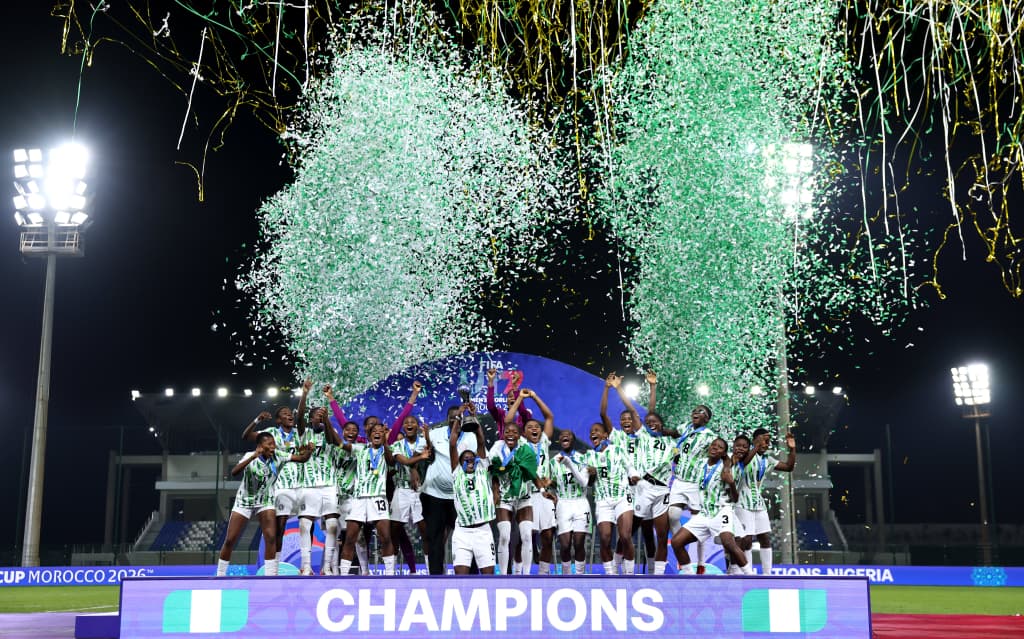
RABAT. Nigeria coach Akeem Busari has credited dedication, determination and discipline for the Flamingos’ historic triumph at the 2026 FIFA U-17 Women’s World Cup.
The Nigerians defeated Japan 2–1 in Saturday’s final in Morocco, becoming the first African side to win a women’s FIFA world title at any level.
Awawu Bashiru opened the scoring in the 39th minute before Oluebube Umejiaku doubled the advantage shortly after half-time at the Mohammed VI Football Complex.
Fuki Ito pulled a goal back in the 80th minute, but Nigeria protected their lead to complete a campaign featuring six consecutive victories after an opening defeat.
For Busari, the final demanded careful preparation against opponents whose speed and ability to recover possession could punish an open approach.
Japan’s threat from second balls was central to Nigeria’s analysis, with the Flamingos seeking space rather than repeatedly contesting possession in crowded areas.
“Our approach was built around three Ds; dedication, determination and discipline,” Busari said.
“We had to play to our strengths. If we opened the game up too much, Japan’s speed would give them more opportunities in one-on-one situations.”
Nigeria’s second goal illustrated the value of that approach. Esther Stephen played forward for Umejiaku, who controlled the ball before lifting her finish over goalkeeper Kou Kadowaki.
Japan’s late response came from a corner, with Anri Ito heading across goal for Fuki Ito to score and set up a tense finish.
“We needed to defend in units, in pairs and as a team,” Busari explained.
“It was a tactical contest, almost like chess or draughts. You block one route, and your opponent tries to block another.”
From opening setback to champions
Nigeria’s campaign began with a 2–1 defeat to Poland, whose goals came through Wiktoria Skrzypczak and Natalia Skrok before Umejiaku reduced the deficit.
The Flamingos responded by beating Puerto Rico 2–0, with Oluwakemi Adegbuyi opening the scoring and substitute Precious Oscar securing victory late on.
Their biggest group-stage statement followed against defending champions DPR Korea, whom they defeated 3–1 to secure a place in the knockout rounds.
Adegbuyi, Umejiaku and Kanyinsola Yusuf scored for Nigeria, while Yu Jong-hyang replied for the holders. The result left Nigeria, Poland and DPR Korea level on six points.
In the round of 16, Umejiaku and Mary Dunstan struck in a 2–1 victory over Mexico, whose consolation came through Emily Delgado.
Captain Azeezat Oduntan then converted an 89th-minute penalty against Venezuela, earning a 1–0 quarter-final victory and a meeting with Brazil.
Queen Joseph opened the scoring in the semi-final before Bashiru added a brace, with Greise Kelly replying as Nigeria won 3–1.
Bashiru collected the Player of the Match award on her first start of the tournament, then justified her continued selection by scoring again against Japan.
Umejiaku takes top individual honour
Umejiaku’s decisive contribution in the final earned her the Player of the Match award and completed a four-goal tournament.
She also received the Golden Ball as the competition’s outstanding player, with DPR Korea’s Yu Jong-hyang taking the Silver Ball and Japan’s Fuki Ito the Bronze Ball.
USA forward Maddie DiMaria claimed the Golden Boot with 12 goals. Yu received the Silver Boot, while compatriot Ri Ui-gyong collected the Bronze Boot.
DPR Korea goalkeeper Kim Son-gyong won the Golden Glove, and Japan received the Fair Play Trophy.
For Busari, Nigeria’s achievement also demonstrated the potential of African women’s football, provided development continues beyond individual tournament successes.
“This is not a fluke. It is about development, character and the willingness to keep fighting until we get things right,” he said.
The coach also acknowledged supporters in Nigeria and Morocco, those who travelled from Egypt, and messages of encouragement from other African countries.
Having begun their campaign with defeat, the Flamingos finished with both the world title and the tournament’s leading individual honour, setting a new benchmark for African women’s football.