

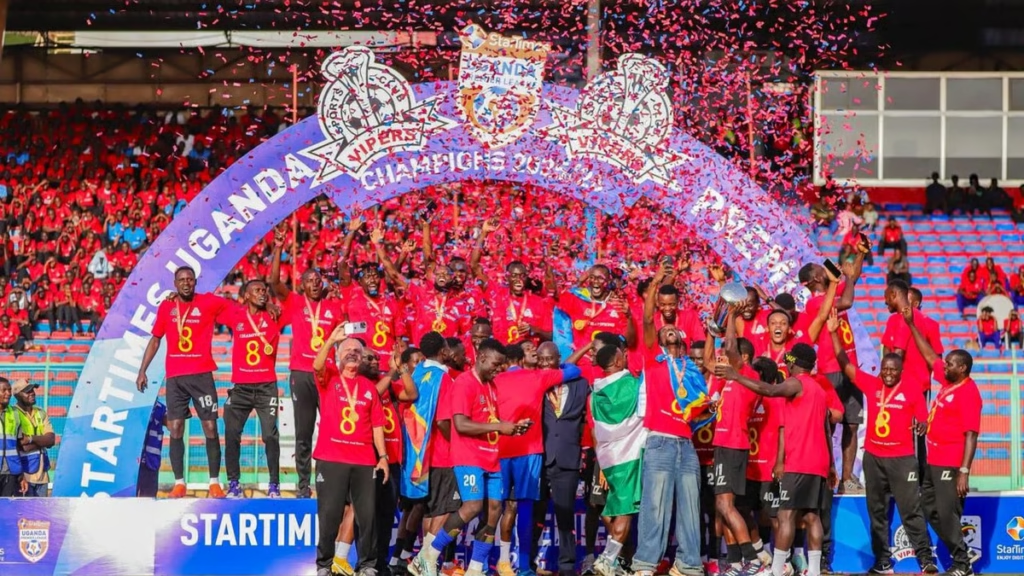
Winning the Uganda Premier League has rarely been about simply assembling the most recognisable names or spending more money than everyone else.
Recent champions have taken different routes to the title. SC Villa ended a 20-year drought by surviving a dramatic final-day shootout in 2024, while Vipers dominated the 2021/22 campaign with 74 points before edging KCCA on goal difference the following season.
Express ended their own lengthy wait for the championship in 2021 through consistency, organisation and defensive discipline.
Different teams have therefore won in different ways, but the champions have repeatedly shared several qualities that have separated them from the rest of the competition.
With the 2026/27 Uganda Premier League expanding to 18 clubs and 34 matches per team, those qualities will become even more important as contenders negotiate a longer campaign, additional travel and greater demands on squad depth.
Losing as little as possible
One of the most significant statistics from Vipers’ 2025/26 championship was not simply the number of games they won, but how rarely they lost.
Vipers finished with 67 points from 30 matches after winning 19, drawing 10 and losing only once. KCCA also recorded 19 victories, but their six defeats eventually contributed to a five-point gap between the two sides.
The lesson is that championship teams do not necessarily win every match, but they develop an ability to avoid defeat when performances are below their best.
Villa showed something similar during their 2023/24 title-winning campaign when they lost only four of their 29 matches and finished one point ahead of Vipers and BUL.
Over the course of a long season, turning potential defeats into draws can be just as valuable as producing emphatic victories.
Defence remains the foundation
Ugandan football has consistently rewarded teams that are difficult to break down, and recent title races suggest that defensive organisation remains one of the clearest requirements for becoming champions.
Vipers conceded just 17 goals last season, while Villa also built their campaign around a strong defensive record.
When Villa became champions in 2023/24, they conceded 21 goals in 29 matches, while closest challengers Vipers and BUL allowed 20 and 17 respectively.
The strongest example came in 2022/23 when Vipers conceded only 13 goals in 28 matches before finishing level with KCCA on 53 points and winning the championship on goal difference.
In that season, defensive efficiency quite literally decided where the trophy went.
A title contender therefore cannot depend entirely on its forwards because goalkeepers, defenders, midfield protection and collective organisation often determine whether difficult matches produce one point or none.
Goals must come from different areas
While defensive organisation keeps a team in the championship conversation, goals usually provide the difference between competing for the title and winning it.
Vipers’ dominant 2021/22 side accumulated 74 points from 30 matches and secured the championship with four games remaining, with players such as Yunus Sentamu, Milton Karisa and Bobosi Byaruhanga offering different attacking threats.
KCCA’s successful sides under Mike Mutebi also benefited from goals coming from several areas, rather than depending on one striker throughout the campaign.
That variety becomes especially important over a long season because injuries, suspensions and dips in form can easily disrupt a team that relies heavily on one player.
It is one reason NEC’s recruitment of Fahad Bayo could prove significant this season. NEC showed considerable consistency under Badru Kaddu last term, but their biggest weakness was a lack of goals.
If Bayo provides what was missing while NEC maintain their defensive organisation, they could become a serious title contender.
Champions take care of the smaller fixtures
The biggest matches usually attract the headlines, particularly contests involving Vipers, KCCA and Villa, but championships are often lost elsewhere.
Dropping two points against a struggling side carries exactly the same mathematical consequence as dropping two against a direct title rival, which is why champions develop a habit of taking care of fixtures they are expected to win.
That becomes even more important this season because expansion gives every club four additional matches and, therefore, four more opportunities to drop unexpected points.
The eventual champions may not dominate every major fixture, but they are likely to be the team that is most ruthless against the rest of the league.
Surviving the road
The expanded competition will also increase the importance of travel and logistics.
Clubs will make longer journeys to different parts of the country, and the ability to collect points after difficult travel, on unfamiliar surfaces and against highly motivated opponents will become an important part of the championship equation.
The longer campaign will therefore test recovery, squad management, finances and preparation almost as much as tactical quality.
A champion must be capable of travelling well, recovering quickly and maintaining standards even when conditions are far from ideal.
Home advantage must count
Championship-winning teams usually build a strong home record, and recent Ugandan football provides several examples.
St Mary’s Stadium has become a central part of Vipers’ dominance, while Lugogo played a similar role during KCCA’s championship years under Mutebi.
Home advantage provides more than familiarity with the playing surface because it also brings routine, reduced travelling demands, stronger support and the psychological expectation that visiting teams will struggle.
With 17 home matches this season, any contender that regularly drops points on its own ground will make an already difficult championship challenge considerably harder.
Squad depth could decide the title
The 2026/27 season could place greater emphasis on squad depth than many recent campaigns.
Every club will play 34 league matches, while some contenders will also have continental football, the Uganda Cup, injuries, suspensions and international call-ups to manage.
A team with only 11 strong players is therefore unlikely to survive an entire championship race.
The serious contenders will need a group of perhaps 18 to 22 players whom the coach genuinely trusts, particularly during periods when fixtures come quickly.
Vipers have understood this better than most clubs. Their ability to strengthen even after winning titles has helped ensure that the drop in quality between their first-choice players and replacements remains relatively small.
That kind of depth becomes particularly important in the final months of a season when fatigue and injuries begin to accumulate.
Stability still matters
Championship teams generally develop a clear identity and understand exactly how they want to play.
Mutebi’s KCCA sides had a recognisable football philosophy, while Wasswa Bbosa’s Express were disciplined and difficult to beat. Villa also remained composed during a 2023/24 championship race that went all the way to the final afternoon.
Vipers have occasionally survived coaching changes, but their success still underlines the importance of institutional stability.
Their recruitment, financial strength, facilities and expectations remain relatively consistent even when the technical bench changes.
NEC’s experience last season showed why a strong start also matters. Their improvement under Kaddu came after points had already been dropped earlier in the campaign, meaning their later consistency was not enough to produce a championship challenge.
Titles can therefore be lost long before the final weeks of the season.
Financial stability matters
A 34-match campaign is expensive because clubs must deal with salaries, travel, accommodation, medical costs, bonuses and training expenses throughout the season. Financial stability also removes unnecessary distractions from the dressing room.
Ugandan football has repeatedly shown how quickly delayed salaries and allowances can affect motivation and performances, which makes it extremely difficult for an unstable club to sustain a nine-month title challenge.
The richest club will not automatically become champion, but a functioning financial structure has increasingly become part of the foundation required to compete consistently. That remains one of Vipers’ biggest advantages.
Handling the pressure
There comes a stage in every championship campaign when matches stop feeling like ordinary league fixtures and every result begins to carry the weight of the title.
Villa experienced that in May 2024 when three clubs entered the final day with a chance of becoming champions.
Villa travelled to face NEC knowing victory would secure their first league title in two decades and responded by winning 2-0.
That was not simply about tactics or technical quality because it required the mentality to deliver when the consequences of failure were enormous.
Every champion eventually reaches a moment when winning becomes compulsory, and the ability to handle those moments usually separates champions from contenders.
How many points will it take?
The expansion to 18 clubs makes comparisons with previous seasons more difficult because every team will now play four additional matches.
Recent champions have produced very different totals, with Vipers collecting 74 points in 2021/22, while Villa needed only 57 from 29 matches to win the unusually tight 2023/24 championship.
With 34 fixtures this season, around 70 points should probably be considered the minimum target for a genuine title contender, while a total between 74 and 78 points could be enough to become champions if the leading clubs continue taking points off one another.
That still leaves roughly two points per game as a useful championship benchmark.
Who can win it?
Vipers remain the obvious favourites because they possess arguably the deepest squad, strong infrastructure, financial stability and the experience of repeatedly handling championship pressure.
Their biggest challenge could come from having to balance domestic football with continental commitments, although their depth also makes them better equipped than most clubs to manage that schedule.
KCCA remain one of the strongest challengers after finishing five points behind Vipers last season and matching the champions’ tally of 19 victories.
Their challenge will be reducing the number of defeats and finding greater consistency across a longer campaign.
NEC could be the most intriguing challenger because their improvement under Kaddu suggested that they already have the defensive organisation required to compete near the top.
Their weakness was scoring enough goals, which makes Bayo’s arrival potentially significant.
If NEC maintain their defensive structure and add more goals, they could become the biggest threat to Vipers.
SC Villa should remain in the conversation because they have already demonstrated that they can survive the pressure of a championship race, while Kitara have developed into a competitive side capable of influencing the title battle.
Verdict
There are legitimate arguments for KCCA, NEC and Villa, but predicting a champion requires separating the teams capable of winning the league from the team that currently appears best equipped to do it.
That remains Vipers
They possess the squad depth, defensive organisation, financial stability, infrastructure and championship experience that have repeatedly defined successful teams in Uganda.
My prediction is therefore that Vipers will win the 2026/27 Uganda Premier League, although NEC could emerge as the team most capable of upsetting that expectation if their improved attack complements the defensive organisation they developed last season.
History suggests that the eventual champion will need a defence that rarely gives anything away, goals from several areas, enough depth to survive 34 matches, financial and technical stability, and the mentality to collect points when performances are below their best.
At the moment, Vipers possess that combination more convincingly than anybody else, and the responsibility falls on the other 17 teams to prove otherwise.