

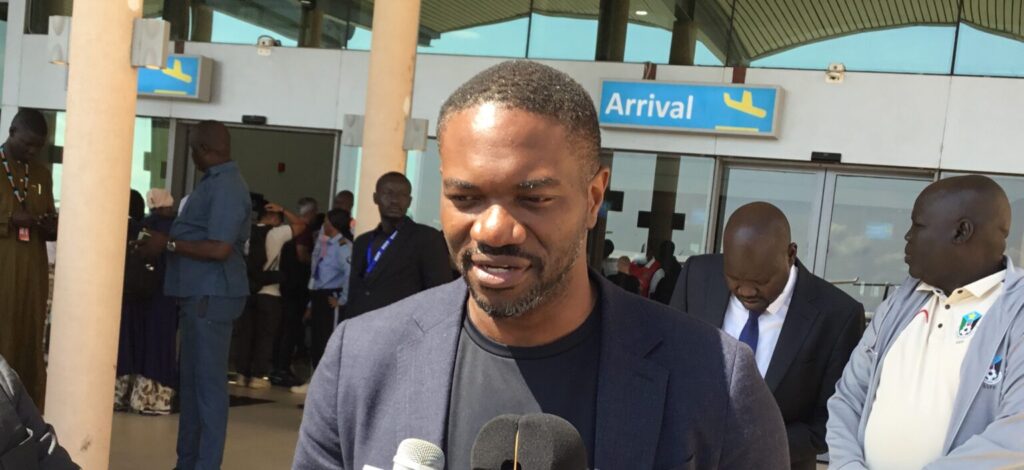
Uganda’s preparations for the 2027 Africa Cup of Nations face another high-level CAF review as senior officials arrive to assess the country’s readiness.
CAF Acting General Secretary Samson Adamu is among officials in Uganda for engagements expected to combine facility inspections with meetings involving the Local Organising Committee and government officials.
Adamu arrives with fresh knowledge of developments elsewhere after accompanying CAF President Patrice Motsepe during high-level engagements in Tanzania and Kenya.
The Uganda mission completes another round of CAF engagements across the three countries preparing to jointly stage Africa’s biggest football tournament.
Uganda, Kenya and Tanzania will host AFCON from June 19 to July 17, 2027, the first edition staged across three countries.
In Tanzania, Motsepe inspected Benjamin Mkapa Stadium and met government and football officials while calling for preparations to accelerate.
“I’m very proud of the good work that’s taking place in Tanzania,” Motsepe said.
“We have nine months and part of my emphasis is we have to speed up, and we are here to work together to help, to assist. This is our AFCON.”
Motsepe also acknowledged that challenges remain across the preparations but reiterated CAF’s commitment to working with the three hosts.
“We’re going to work together, and those areas where we are falling behind, we’ll correct them, we’ll fix them,” he said.
Adamu then accompanied Motsepe to Kenya, where the CAF president met President William Ruto before inspecting Talanta Sports City Stadium and Kasarani Stadium.
CAF said in a statement that Motsepe was impressed by progress at Talanta but provided feedback about work still required at Kasarani before the competition.
Adamu’s return to Uganda comes months after he delivered a clear message about deadlines during an AFCON 2027 workshop at Mestil Hotel in Kampala.
The workshop brought CAF officials together with representatives from Uganda, Kenya and Tanzania to establish responsibilities and milestones towards tournament delivery.
“CHAN was a valuable lesson, but AFCON is a completely different tournament with greater scale, expectations and requirements. We must adopt a new mindset and avoid comparisons,” Adamu said.
He also warned that time was increasingly becoming a factor in preparations.
“We are about one year away, and time is limited. What could wait before cannot wait now. Every moment matters,” Adamu said.
“From this meeting, roles and responsibilities must be clear, and milestones well defined. Strong structures and government support are essential.”
CAF and representatives of the three governments and football federations subsequently established the PAMOJA Oversight Committee to coordinate preparations across the region.
Preparations extend beyond stadium construction to training facilities, accommodation, transport, security, medical services, broadcasting and tournament operations.
Uganda’s preparations currently centre around Mandela National Stadium, Namboole, Hoima City Stadium and other facilities earmarked for the tournament.
The LOC said earlier this month that Uganda remained on course to complete its three competition stadiums by December 2026.
Uganda also has 12 proposed training facilities, with the LOC targeting completion of 10 by December and the remaining two in January.
Adamu has previously stressed that the tournament also presents an economic opportunity for the region beyond staging football matches.
“AFCON is a great opportunity for the region to demonstrate its capability and unity,” Adamu said during the Kampala workshop.
“AFCON in Morocco generated 1.8 billion dollars in direct investment and value, and this shows the potential impact.”
With approximately nine months remaining before kickoff, Adamu’s meetings with the LOC and government officials will provide CAF with another opportunity to review Uganda’s progress against its commitments.
The facility visits will also allow the delegation to assess ongoing projects and identify areas requiring attention as preparations enter their final months.
Adamu’s assessment at the end of the visit should provide a clearer picture of Uganda’s readiness and the work still required before East Africa welcomes the continent in June.