

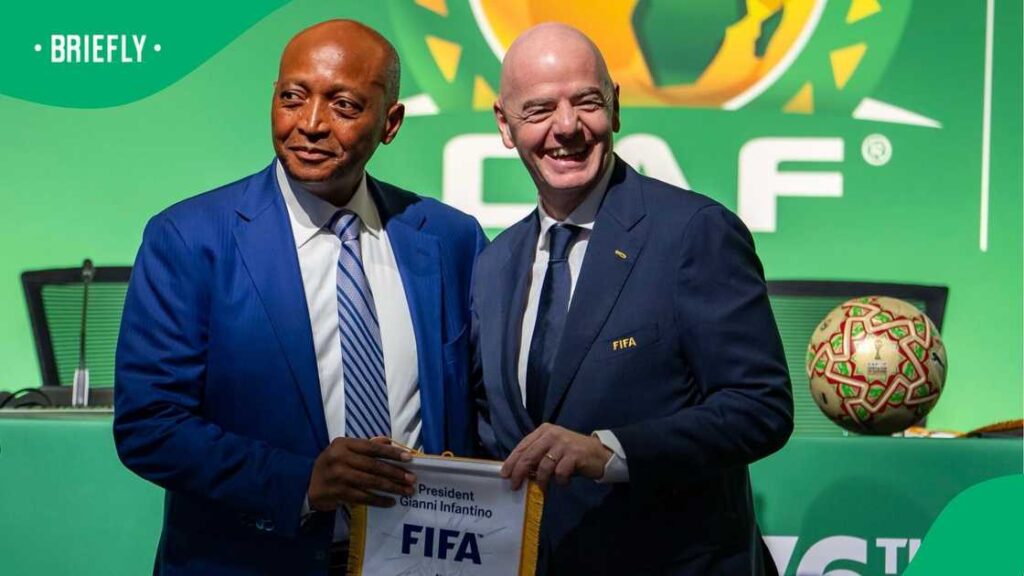
African football has thrown its collective weight behind FIFA president Gianni Infantino, strengthening his re-election campaign amid growing opposition elsewhere.
All 54 Confederation of African Football (CAF) member associations reaffirmed their unconditional support during Thursday’s CAF Strategy Conference in Cape Verde.
The endorsement gives Infantino the declared backing of more than a quarter of FIFA’s 211 voting associations ahead of next year’s presidential election.
It also highlights a growing divide between African football leaders and other confederations over the future direction of world football.
CAF president Patrice Motsepe announced the decision during the conference in Santa Maria, where Infantino addressed African football officials.
“There is a unanimous decision by the 54 CAF member associations to unconditionally support Gianni as president of FIFA,” Motsepe said.
“This is because of the history and the support that Gianni has given to African football.”
The declaration was followed by a standing ovation for Infantino, who has maintained a close relationship with African football leadership.
However, Thursday’s announcement was not Africa’s first commitment to the Swiss-Italian administrator, who has led FIFA since February 2016.
CAF had already unanimously endorsed his re-election for the 2027–2031 term during a meeting in Vancouver, Canada, on April 29.
The latest declaration reinforces that position at a time when Infantino faces criticism over his proposed restructuring of FIFA’s commercial operations.
Opposition grows outside Africa
Infantino’s leadership has faced renewed scrutiny following his unsuccessful proposal to sell a minority stake in FIFA’s major competitions to private investors.
The proposed commercial restructuring would have included flagship tournaments such as the FIFA World Cup and the expanded FIFA Club World Cup.
However, opposition from European, Asian and North American football authorities forced FIFA to abandon the proposal earlier this year.
Critics questioned the commercial arrangements, governance implications and consultation surrounding a plan that could have significantly changed FIFA’s financial structure.
The controversy prompted several football associations outside Africa to reconsider their support for Infantino ahead of the March 18, 2027 election in Rabat, Morocco.
Former Switzerland international Ramon Vega announced on Wednesday his intention to challenge Infantino for the FIFA presidency.
Meanwhile, UEFA president Aleksander Ceferin confirmed on Thursday that he would seek another term leading European football rather than contest FIFA’s presidency.
Why Africa is standing with Infantino
Africa’s support comes against a decade of increased FIFA development funding and expanded opportunities for the continent’s national teams.
Infantino told delegates that FIFA had invested approximately $1 billion in African football through its Forward development programme since 2016.
The investment has supported 124 projects across the continent, including football infrastructure and development initiatives.
“With the FIFA Forward programme we have invested one billion dollars in 10 years in Africa, with 124 different projects and many other actions,” Infantino said.
He also pledged continued financial support, stressing that African football must receive additional resources to strengthen its international competitiveness.
“We will continue to look for the resources and the increases (in funding) that are necessary to boost the African game to the top of world football,” he added.
Africa’s representation at the World Cup has also expanded significantly during Infantino’s presidency.
The continent previously had five guaranteed places at the tournament before FIFA expanded the competition to 48 teams.
Africa secured nine automatic qualification places for the 2026 World Cup, with another available through the intercontinental play-offs.
The expanded tournament ultimately featured 10 African representatives, marking the continent’s largest participation in World Cup history.
Motsepe defends FIFA relationship
Motsepe also defended CAF’s relationship with Infantino, rejecting suggestions that African football authorities place political alliances above governance and transparency.
He challenged anyone with allegations against FIFA or CAF officials to pursue them through the appropriate ethics procedures.
“If anybody has any allegation or any accusation against Gianni Infantino or me or any other president, go to the FIFA ethics committee,” Motsepe said.
The CAF president maintained that good governance remained central to African football’s development ambitions.
“For us, governance and ethics and transparency and due process is a matter of life and death,” he said.
Motsepe also challenged African associations to translate increased investment into improved performances, particularly at the World Cup.
“One of the nations from Africa will win the World Cup,” he said, emphasising the importance of developing academies and young players.
“But we’ve got to spend more investment in our academies, in our youth.”
He argued that African football could not achieve its ambitions through declarations and development strategies without meaningful financial commitments.
What Africa’s backing means
Africa’s 54 associations represent approximately 25.6% of FIFA’s voting membership, making their collective endorsement particularly significant.
Under FIFA’s voting structure, each member association has one vote regardless of its size, population or footballing achievements.
However, CAF’s public declaration does not automatically guarantee that every African association will vote for Infantino when the election takes place.
The endorsement nevertheless provides an important political foundation as Infantino prepares to seek another four-year term.
For Uganda, Kenya and Tanzania, which are preparing to co-host the 2027 Africa Cup of Nations, the wider relationship between FIFA and African football remains particularly relevant.
Continued investment in infrastructure, technical development and youth football will be important as the three countries strengthen their football systems beyond the tournament.
The Cape Verde conference has also brought together national association presidents, coaches and technical experts to review Africa’s performance at the 2026 World Cup.
Discussions will examine development priorities and the measures required to improve the continent’s competitiveness ahead of the 2030 tournament.