

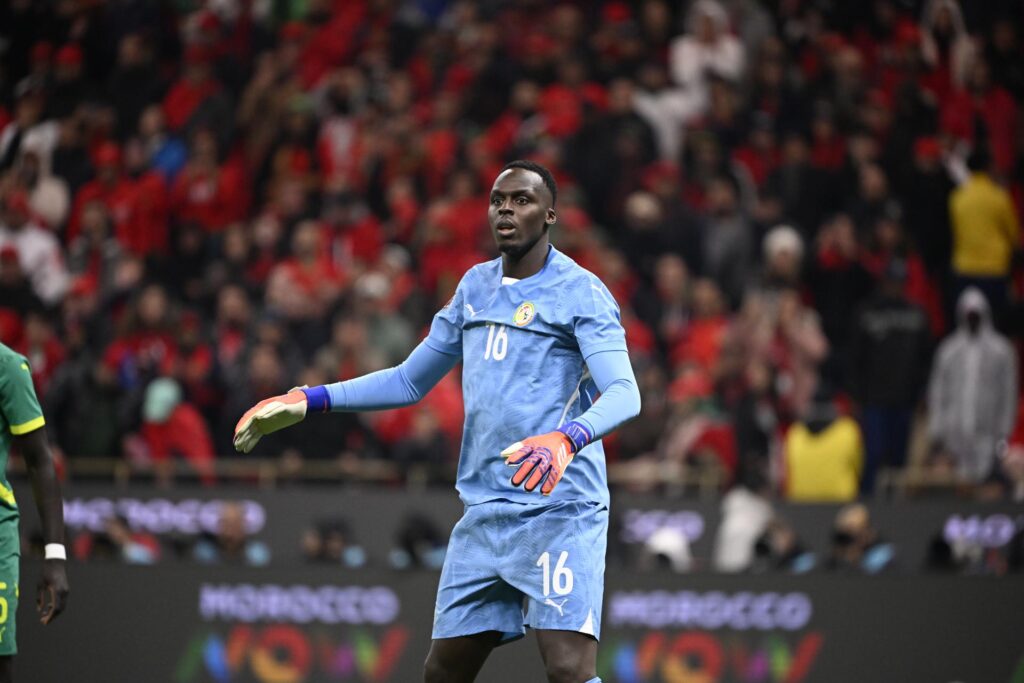
Édouard Mendy’s international retirement is more than the departure of Senegal’s first-choice goalkeeper. It represents another unmistakable signal that one of Africa’s most successful generations is approaching a period of transition.
Mendy announced his retirement on Sunday after eight years and 59 appearances for the Teranga Lions. The 34-year-old finishes with 31 clean sheets from those matches, having conceded only 34 goals.
His timing makes the decision particularly significant, Patrick Vieira was officially appointed Senegal coach on August 18th, 2026, inheriting a squad still carrying several figures associated with the country’s greatest period.
Mendy’s departure therefore removes one major decision from Vieira while creating an immediate succession problem.
Mendy was not merely another experienced goalkeeper, he became part of Senegal’s spine alongside Kalidou Koulibaly, Idrissa Gueye and Sadio Mané, helping transform a talented side into African champions.
His defining international moment came at the 2021 Africa Cup of Nations in Cameroon, where Senegal defeated Egypt on penalties to win their first continental title.
Mendy finished that tournament as its best goalkeeper after playing a decisive role throughout the knockout rounds.
That experience cannot simply be replaced through another goalkeeper receiving the number one shirt. Vieira must now decide whether Senegal require continuity or a complete reset between the posts.
Yehvann Diouf and Mory Diaw were the other goalkeepers selected alongside Mendy for the 2026 World Cup. Diouf, particularly, represents a younger option around whom Senegal could build towards AFCON 2027 and beyond.
The challenge will be allowing the next goalkeeper to develop authority without constantly measuring him against Mendy.
Goalkeepers often remain internationals beyond 34, meaning Mendy could reasonably have continued through another AFCON cycle. His decision therefore accelerates a transition Senegal may otherwise have postponed.
It could also become part of a broader generational conversation; Mané is 34, Koulibaly is 35 and Gueye turns 37 later this month. The four were described during the World Cup as central figures carrying the memory of Senegal’s recent success.
Vieira consequently inherits something more complicated than an ageing squad. He inherits a winning culture whose most influential players cannot remain forever.
The temptation will be to replace experience quickly with youth, but successful transitions rarely work through wholesale removal.
Senegal already possess emerging players capable of taking greater responsibility, particularly across midfield and attack. What Vieira needs is an orderly transfer of authority while maintaining the standards established during the previous cycle.
Mendy has effectively made the first decision himself; his 59 caps, AFCON triumph and international reputation leave Senegal with a goalkeeper position carrying unusually heavy expectations.
For Vieira, finding another goalkeeper may be straightforward but finding another figure capable of providing the same confidence, calmness and big-match experience could take considerably longer.