

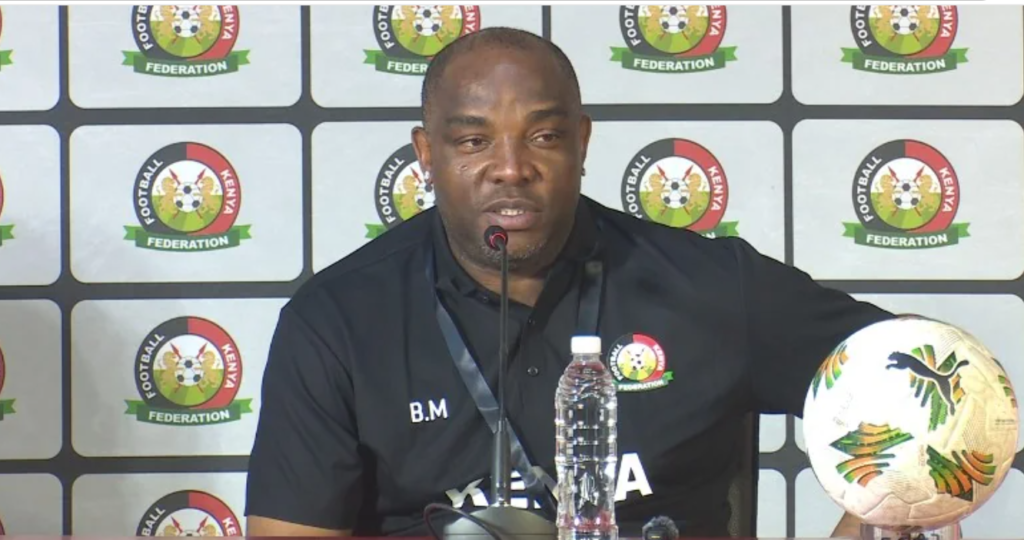
Kenya coach Benni McCarthy has questioned his country’s ability to challenge for the 2027 Africa Cup of Nations title, warning that hosting the tournament does not automatically make Harambee Stars contenders.
With Kenya preparing to co-host AFCON 2027 alongside Uganda and Tanzania, McCarthy believes the country’s football structures and playing resources remain significantly behind Africa’s established powers.
The South African insists that even substantial financial incentives would not immediately transform Kenya into a team capable of challenging Morocco, Senegal, Egypt and Côte d’Ivoire.
“Even if you were to pay me millions and millions of dollars to win AFCON, I don’t think Kenya has the resources and the team strong enough to compete with Morocco, Egypt, Côte d’Ivoire, Senegal,” McCarthy said.
“Those are powerhouses in African football. Kenya can win AFCON, but it’s highly unlikely we would have a chance to win.”
His assessment comes eight months before East Africa hosts its first Africa Cup of Nations, scheduled for June 19 to July 17, 2027.
For Kenya, the challenge extends beyond competing against stronger opponents to overcoming a history of limited success at continental level.
Harambee Stars have appeared at six AFCON tournaments, in 1972, 1988, 1990, 1992, 2004 and 2019, without progressing beyond the group stage.
Their first tournament victory came in 2004, when they defeated Burkina Faso 3-0, ending a lengthy wait for an AFCON win.
Kenya’s most recent appearance came in Egypt in 2019, where they again failed to reach the knockout stages.
That record contrasts sharply with the achievements of the nations McCarthy identifies as serious contenders.
Egypt have won a record seven AFCON titles, while Côte d’Ivoire claimed their third championship on home soil in 2024.
Senegal have also established themselves among Africa’s strongest teams, winning their first continental title in 2022.
Morocco’s rise has been equally significant, highlighted by their historic run to the 2022 FIFA World Cup semi-finals.
Those achievements illustrate the international experience and competitive standards Kenya must overcome to become genuine title challengers.
McCarthy believes the quality of players available to Africa’s leading nations remains a major difference.
“When you have teams like South Africa and Guinea, who have so many players who play in the top leagues in the world and then you have Kenya, we are a very humble team,” he explained.
“If people are expecting me to beat Bafana, to beat Morocco, to beat Senegal, it’s very hard.”
The former Manchester United assistant coach also faces immediate concerns about Kenya’s preparation and competitive performances.
Harambee Stars opened their 2027 AFCON qualifying campaign with a disappointing 1-1 draw against Eritrea in Nairobi.
They subsequently suffered a 1-0 defeat against Guinea in Conakry, with Borussia Dortmund striker Serhou Guirassy scoring the decisive goal.
Those results left Kenya with one point from their opening two Group D matches, increasing scrutiny of McCarthy’s progress.
South Africa, meanwhile, opened with victories against Guinea and Eritrea, including a commanding 5-0 win over the latter.
The contrasting results underline the competitive gap McCarthy believes Kenya must address before next year’s tournament.
Beyond international results, the delayed start of Kenya’s 2026/27 SportPesa Premier League has complicated preparations for domestically based players.
McCarthy questioned how local footballers could compete for national team selection without regular competitive matches.
“People are calling for Kenyan players, but the league has not even started, none of the players in Kenya has played a single league match,” he said.
His concerns highlight the importance of domestic competition in developing match fitness, maintaining player standards and strengthening national team depth.
Despite those difficulties, McCarthy believes Kenya’s emerging generation of footballers offers encouragement for the country’s long-term development.
“Kenya doesn’t have a long history in African football, where they’ve done well in previous AFCONs,” he said.
“But now we have a new generation of players, young players. Many of them play their football in Europe.”
He believes the experience accumulated through international matches could gradually improve Kenya’s ability to compete against stronger opponents.
However, McCarthy has suggested that winning the continental championship might require another decade of sustained development. “But to win AFCON, maybe 10 years from now,” he said.
His comments also raise wider questions about the ambitions of the three East African countries preparing to host AFCON 2027.
Uganda, Kenya and Tanzania are investing in stadiums, training facilities and tournament infrastructure to meet the Confederation of African Football’s hosting requirements.
However, success in delivering the tournament will not necessarily translate into improved performances by their national teams.
Uganda’s best AFCON finish remains the 1978 final, when the Cranes lost 2-0 to hosts Ghana.
The Cranes last reached the knockout stages in 2019, progressing to the round of 16 before losing 1-0 to Senegal.
Tanzania have appeared at four AFCON tournaments, including the 2025 edition, but have yet to establish themselves as consistent knockout-stage contenders.
For all three countries, the home tournament presents an opportunity to improve those records while building foundations for future competitions.
McCarthy believes reaching the knockout stages would represent a more realistic starting point than immediately targeting the championship.
“For us, the main objective is to host the tournament and make sure that the AFCON is a big success for Kenya, for Tanzania, and for Uganda,” he said.
He hopes the three countries can progress beyond the group stage before gradually challenging for quarter-final and semi-final places.
His position reflects the distinction between the organisational success of hosting a major tournament and the sustained investment required to produce competitive national teams.
Kenya’s next major examination comes in November, when Harambee Stars face South Africa in their AFCON qualifying double-header.
Those matches should provide another indication of whether McCarthy’s developing squad can narrow the gap against established African opposition.
For Kenya and its East African co-hosts, AFCON 2027 may ultimately be judged by more than stadium readiness and tournament organisation.
The lasting challenge will be turning the opportunity to host Africa’s biggest football event into meaningful progress on the pitch.