

Government financial support to Uganda Premier League clubs could more than double in the coming years if clubs demonstrate accountability in using the historic Shs5.5bn allocation.
FUFA Super League Limited chairman Dr Arinaitwe Rugyendo revealed that indications have already emerged that further government investment could depend on how responsibly clubs handle the first direct subvention.
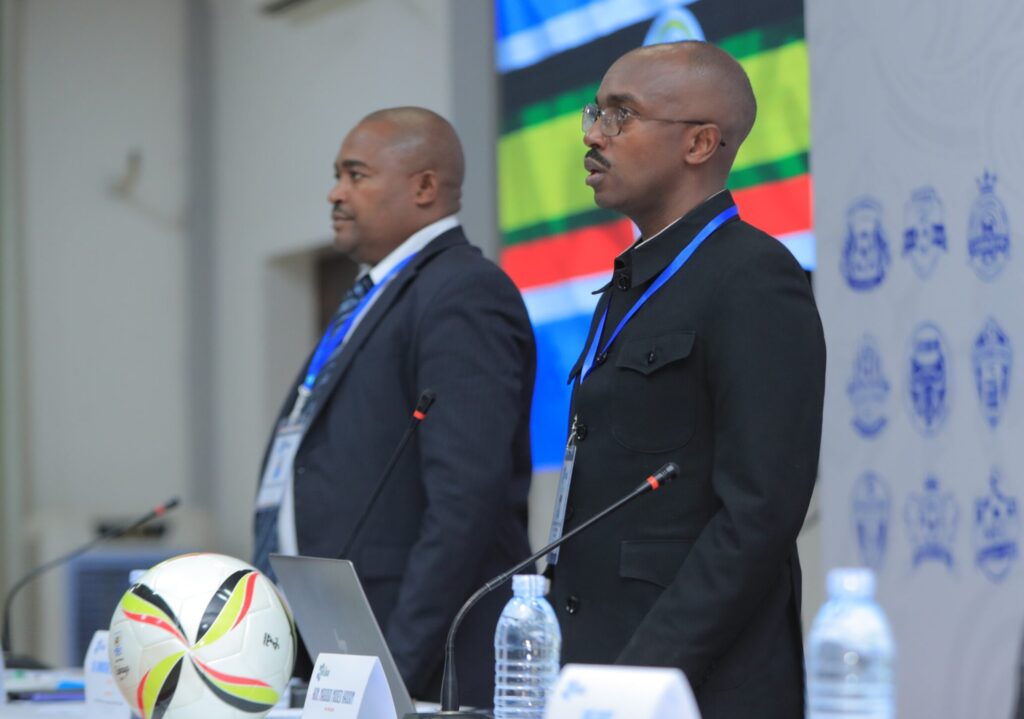
Rugyendo made the revelation at the 13th Annual General Meeting of the FUFA Super League Limited at HB Hotel in Hoima City on Saturday.
For the first time, government has extended direct financial support to Uganda Premier League clubs, with the Shs5.5bn allocation going to the 18 clubs competing in the 2026/27 season.
Rugyendo described the intervention as a turning point for the domestic league but warned clubs that their management of the money could determine the future of government support.
“I appeal to every club, every Chairman and every Chief Executive in this room: do not abuse the Government subvention,” Rugyendo said.
“Use these resources for the purpose for which they were intended strengthening club administration, developing players, improving facilities and enhancing the welfare of the people who make our football possible.”
Rugyendo then offered perhaps the clearest indication yet that the Shs5.5bn intervention may not necessarily represent the ceiling of government investment in Premier League clubs.
“I have it on good authority, and I have heard it repeated in more than one corridor, that if our clubs demonstrate discipline, transparency and good behaviour in how this subvention is applied, this support will more than double in the years ahead,” Rugyendo said.
“Let that possibility be the standard against which every shilling is spent. We hold in our hands not just today’s support, but the case for tomorrow’s increase.”
Rugyendo did not provide a proposed figure or timeline for a potential increase, meaning any future allocation would still depend on subsequent government decisions.
However, doubling the current Shs5.5bn package would take annual government support for Premier League clubs beyond Shs11bn.
The current intervention followed sustained engagement between the league and government, culminating in direct financial support to the clubs.
Rugyendo said the significance of the intervention extends beyond the money received because government backing could strengthen the league’s position when seeking private-sector investment.
“Government support of this nature means far more than the money itself. It is a stamp of pedigree on our league,” Rugyendo said.
“It tells the country, and indeed the region, that the Uganda Premier League is now recognised at the highest level as a serious, credible and strategically important institution.”
Rugyendo argued that greater government confidence could subsequently help clubs and the league secure stronger sponsorship agreements and improve the commercial value of the competition.
Rugyendo also credited improvements in governance, club licensing, financial discipline and professional administration for strengthening confidence in the league.
“That trust should translate into real fortunes for our clubs better sponsorship deals, stronger broadcast value, and a more attractive product for every partner who wishes to associate with Ugandan football,” he said.
The league is now pushing for the government intervention to extend beyond the 18 participating clubs.
Rugyendo revealed that FSLL has formally requested support for the UPL Secretariat and UPL SACCO, describing the administrative arm as effectively the league’s “19th club.”
“We reiterate our appeal to government to think about the 19th club which is the UPL Secretariat and UPL SACCO,” the chairman said, adding that the request had been submitted in writing to ministry officials.
For the 18 clubs, however, the immediate challenge will be demonstrating that the first direct government investment has been used for its intended purposes.
Their performance off the pitch could ultimately influence whether the historic Shs5.5bn intervention becomes the foundation for significantly greater government investment in Uganda’s top-flight league.