

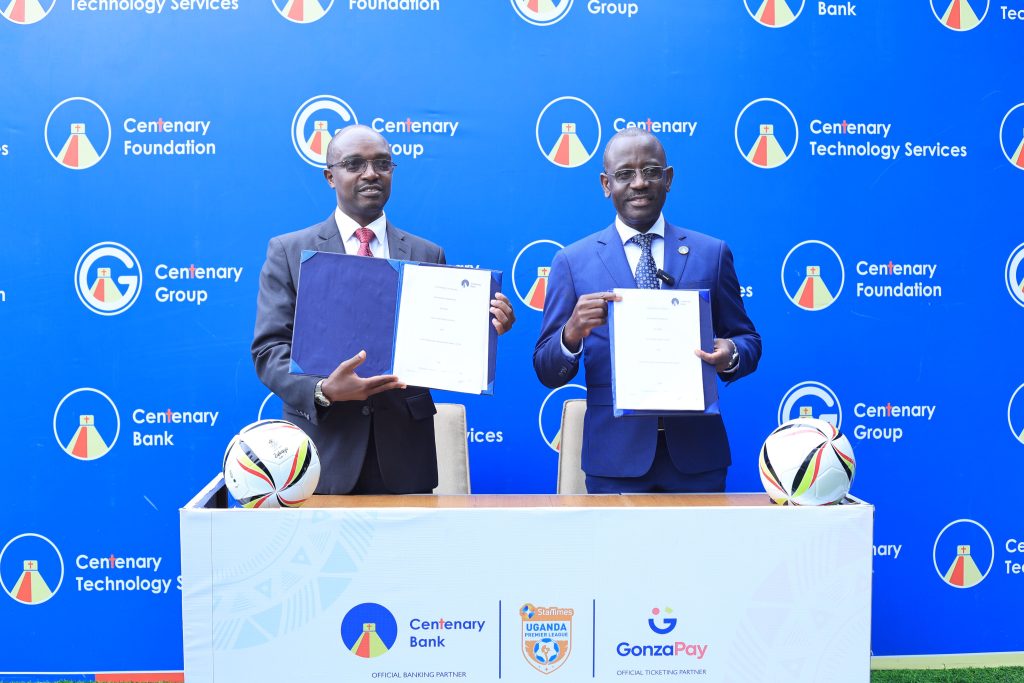
The Uganda Premier League is targeting further corporate investment after securing a Shs204m partnership with Centenary Bank on Monday.
The agreement gives the league additional funding and digital ticketing support as administrators seek to expand football’s commercial appeal.
However, UPL chief executive Bernard Bainamani believes the bigger breakthrough is winning corporate trust after years of disputes discouraged potential sponsors.
“I personally don’t look at the figures in the contract. It’s the confidence the sponsors have shown by investing their money. This is what we have to protect jealously,” Bainamani said.
Unveiled at Mapeera House in Kampala, the partnership takes immediate effect and makes Centenary Bank the league’s official banking partner.
It allocates Shs100m to league operations, Shs100m to media activities and Shs4m towards cash prizes, supporting several competition needs.
Centenary’s Gonza Pay platform will also power digital ticketing at league matches, connecting the bank’s financial services to matchday activities.
The UPL now hopes to attract more companies, particularly from brewing and telecommunications, alongside its existing relationship with broadcaster StarTimes.
Moving beyond institutional disputes
Bainamani acknowledged that the league’s commercial ambitions had previously suffered because of its operating structures and persistent negative publicity.
“It has actually taken us so long to get partners because of the structures we were operating in,” he said.
“But the biggest setback has been the negative stories around the Uganda Premier League. This has stalled us a lot in many spheres.
“There have been many wars and many corporate partners don’t want to associate themselves with sports associations that are at war.
“But the wars have now ceased, and the next step in our strategy is to commercialise the sport while creating awareness among the fans and clubs to take the sport as a commercial product rather than a leisure investment.”
His assessment places responsibility on league administrators and clubs to protect the stability needed to attract and retain commercial partners.
Bainamani also believes improvements in playing facilities have strengthened the league’s prospects, providing more opportunities for television coverage across venues.
“When SuperSport were broadcast partners, they could only broadcast games from Mandela National Stadium, Namboole, as many of the facilities were inappropriate.
“Now there are many grounds that meet international standards,” he said.
Alongside infrastructure improvements, clubs are being encouraged to employ trained personnel as the league seeks stronger administration and commercial growth.
Player welfare and value for fans
UPL board chairman Arinaitwe Rugyendo described Centenary’s investment as “a huge milestone in our struggle to build a football economy in this country.”
For Rugyendo, attracting money into domestic football should translate into tangible benefits for the players and supporters sustaining the competition.
“It’s a huge milestone in our struggle to bring money into the league to make sure that we cater for the welfare of our players, and also make sure that our fans also get value for their money.”
The funding breakdown identifies support for operations, media and prizes, although the announcement does not specify individual club allocations.
Centenary sees opportunity in football’s reach
Centenary Bank managing director Godfrey Byekwaso said the partnership reflects football’s ability to connect communities already served by the institution.
“We know that football connects Ugandans, and we thought that with that infrastructure we need to support an institution that supports the same people we serve,” Byekwaso said.
He said young people account for 38 per cent of the bank’s customers, strengthening the appeal of football and digital financial services.
Byekwaso added that Centenary allocates approximately 1.5 per cent of its profits to corporate social responsibility across several sectors.
Those activities cover health, sport, education and the environment, with existing sporting involvement including the Masaza Cup and Rotary initiatives.
The bank supports Rotary five-a-side football tournaments and the Rotary Cancer Run, while Byekwaso suggested its football ambitions could eventually expand.
“Maybe one time we shall have a football club in the Uganda Premier League. Wherever we go, we tend to be number one,” he said.
No club ownership commitment was announced, leaving the immediate focus on implementing the sponsorship agreement and introducing digital match ticketing.
Delivering those commitments will be an early test of its ability to turn renewed sponsor confidence into lasting commercial support.