

Kenya’s new Talanta Sports City is taking a different approach to stadium construction in a region where many of the biggest football venues have traditionally doubled as athletics arenas.
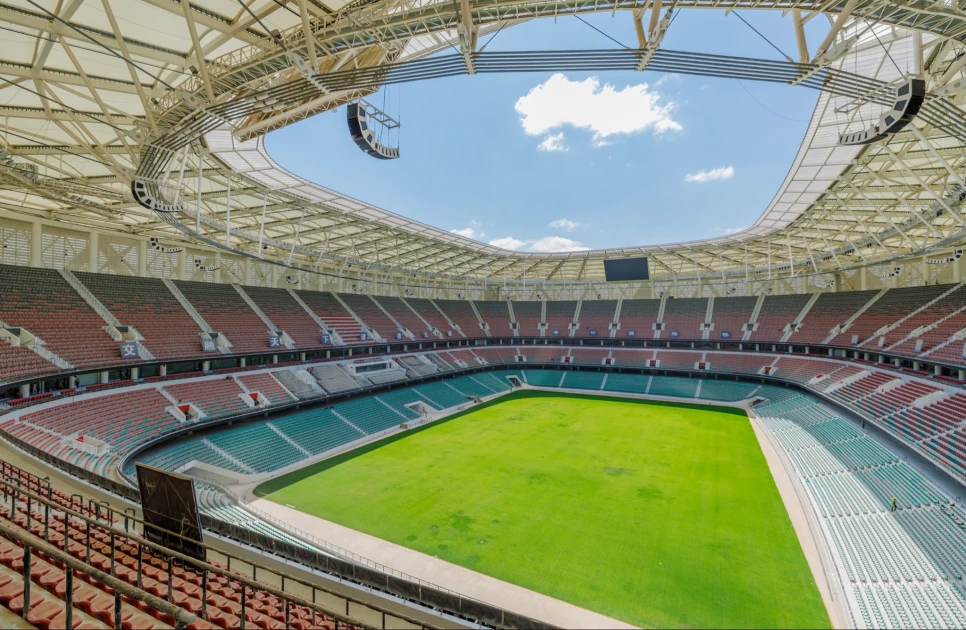
The 60,000-seat stadium in Nairobi has been designed primarily for football and rugby, with no athletics running track separating supporters from the playing surface, a feature that will give it a markedly different match-day feel when it hosts games at the 2027 Africa Cup of Nations.
Kenya’s Ministry of Defence has officially described Talanta as a “football/rugby specific stadium”, while the project’s financing documents identify its centrepiece as a 60,000-capacity football and rugby arena with a FIFA-compliant natural grass pitch measuring 105 by 68 metres.
It represents a significant departure from the design of several of East Africa’s established national stadiums, where football pitches sit inside athletics tracks.
Kenya’s Moi International Sports Centre, Kasarani and Nyayo National Stadium follow the multipurpose model, as does Uganda’s Mandela National Stadium, Namboole.
Without a running track occupying the space between the pitch and terraces, spectators at Talanta will sit considerably closer to the action. The design improves sightlines and can create the more enclosed atmosphere associated with purpose-built football grounds.
Recent details about the project confirm that this was a deliberate design decision rather than athletics being overlooked.
Athletics facilities have instead been separated from the main arena. The wider Talanta complex includes three auxiliary pitches, with two incorporating running tracks, while another is configured for football and rugby.
Former Kenyan Sports Cabinet Secretary Ababu Namwamba explained the distinction when the project was launched in 2024. “Talanta Stadium will only host football, rugby, and concerts and not athletics,” Namwamba said.
President William Ruto later reinforced the arrangement during an inspection of construction works, explaining that while the main stadium contains the football pitch, athletics and rugby training facilities are provided elsewhere within the complex.
The decision could make Talanta one of the more distinctive major football venues in the region when AFCON arrives in 2027.
For decades, multipurpose stadiums have offered African governments an attractive proposition because a single facility can accommodate football, athletics, national celebrations, concerts and other events.
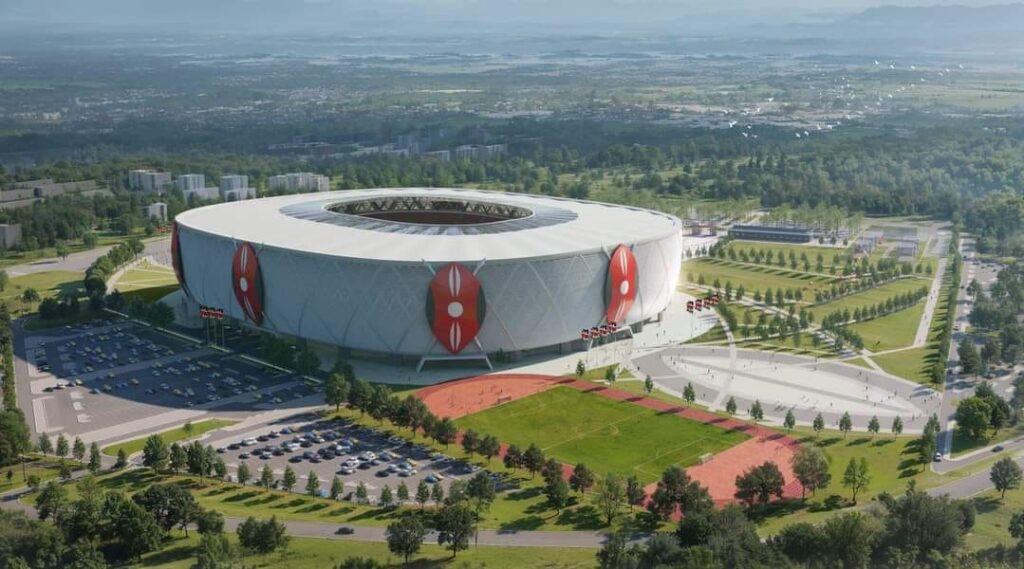
But that versatility comes with a compromise for football. Running tracks increase the distance between spectators and the pitch, particularly behind the goals, while football-specific stadiums allow stands to be constructed closer to the field.
Talanta’s design therefore represents more than an architectural choice. It reflects a decision to prioritise the football and rugby spectator experience in the main arena while accommodating athletics separately.
That does not mean the stadium will serve only sport. Concerts and other suitable major events can also be staged there, but athletics will not dictate the geometry of the main bowl.
The project is also being built with major international football in mind. Kenya will co-host the 2027 Africa Cup of Nations with Uganda and Tanzania, making Talanta one of the centrepieces of the three countries’ infrastructure programme.
As of August 19, 2026, the wider Talanta Sports Complex was reported to be more than 92 percent complete.
For East Africa, however, Talanta could leave a legacy beyond AFCON. Its biggest contribution may eventually be demonstrating that major national sports complexes do not necessarily require every discipline to occupy the same stadium.