

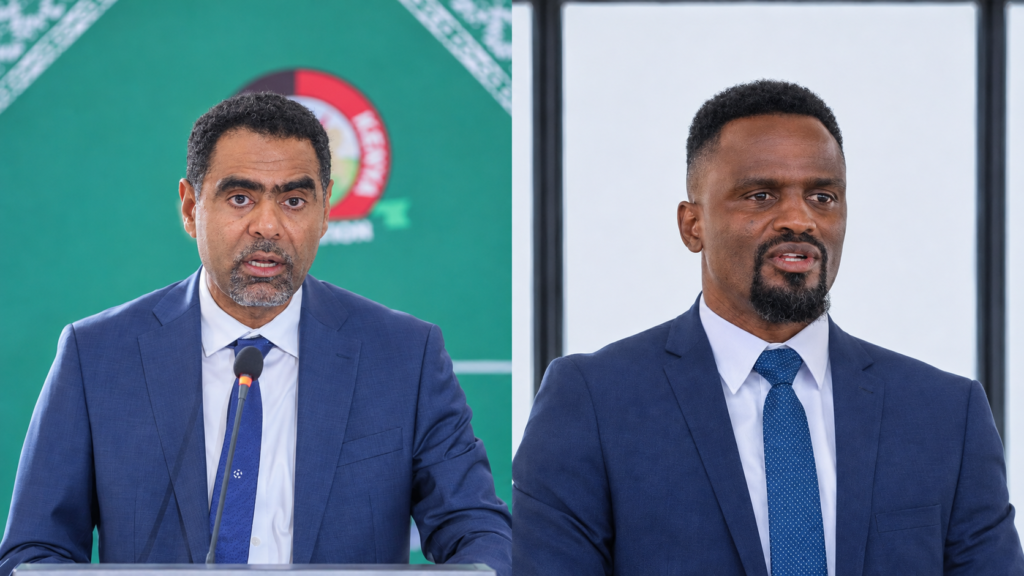
NAIROBI. Hussein Mohamed says his partnership with McDonald Mariga broke down over leadership responsibilities, while his former deputy maintains he is being punished for demanding accountability.
The partnership that carried Hussein Mohamed and McDonald Mariga into Football Kenya Federation leadership has collapsed, exposing deep divisions within Kenyan football.
Once allies under the “Team Fresh” campaign, the pair now offer competing explanations for a fallout that culminated in Mariga’s disputed expulsion.
Speaking to the Daily Nation, Hussein accused his deputy of seeking control over federation operations and attempting to undermine his authority.
“Mariga wanted to be the president and had the intention of pushing me aside. I don’t regret what has happened to him,” he told the Daily Nation.
Hussein traced their disagreements to their first National Executive Committee meeting in January 2025, shortly after their election the previous December.
According to his account, Mariga sought extensive influence over federation affairs, creating friction over the boundaries of their respective responsibilities.
“He wanted to control the national teams, the leagues, management and even sponsorship. He wanted everything to revolve around him. I was elected president, and he was my deputy, so why would I allow that?” Hussein said.
“Mariga travelled in almost all trips with the national teams, some of which I even financed from my own pocket.”
Hussein also questioned his former deputy’s expectations of financial support, alleging that his demands extended beyond resources needed to discharge his responsibilities.
“He wanted to sit in every committee to serve his interests. Recently, he claimed he was not being paid a salary,” Hussein said.
“But where was I supposed to get the money for his salary, bodyguards, office secretary and full-time driver he wanted? Was he coming to FKF for leadership or personal benefits?”
Mariga has offered a different account, claiming that he was sidelined and that the federation failed to fund his official duties.
He maintains that he is being punished for demanding accountability, disputing Hussein’s portrayal of their disagreement as a struggle for control and personal benefits.
Their differences escalated in April 2026, when Mariga’s faction sought Hussein’s suspension over alleged African Nations Championship insurance irregularities.
Hussein denied personal involvement in wrongdoing, saying Caf handled the insurance cover.
The confrontation reached a decisive stage on November 7, when an FKF Special General Meeting in Meru resolved to expel Mariga and six NEC members.
Those affected alongside him were Robert Macharia, Bernard Lagat, Kerubo Momanyi, Collins Opiyo Kalee, Gabriel Mghendi and Dan Shikanda.
FKF said delegates considered allegations of constitutional breaches, repeated failure to attend NEC meetings and unauthorised communication on the federation’s behalf.
The April attempt to remove Hussein and other federation officials was also among the matters considered during proceedings.
Police intervened amid disorder at the venue, delaying the start of a meeting that has since become the subject of further controversy.
Mariga has rejected the outcome, arguing that the affected officials were denied an opportunity to defend themselves and that the voting process breached FKF procedures.
“A resolution reached through acclamation cannot substitute for the secret ballot expressly required by the Constitution,” Mariga said in a statement reported by Nation.
He alleged that the seven officials and 32 accredited delegates were denied access, while Hussein maintained that they were invited to make submissions.
Mariga’s faction insists its members remain in office and has requested scrutiny of the meeting’s attendance, delegate credentials, quorum and voting process.
In its reporting on his response, Kenya News Agency quoted Mariga stressing the importance of the voting requirement.
“This is a mandatory constitutional requirement, not an optional procedure,” he said.
FKF maintains that its General Assembly acted within its constitutional mandate, leaving the two sides sharply divided over the legitimacy of the decision.
The dispute comes as Kenya prepares to co-host the 2027 Africa Cup of Nations alongside Uganda and Tanzania, increasing the importance of administrative stability.
Previously Fifa had expressed concern about leadership disputes hindering football development in the country.