

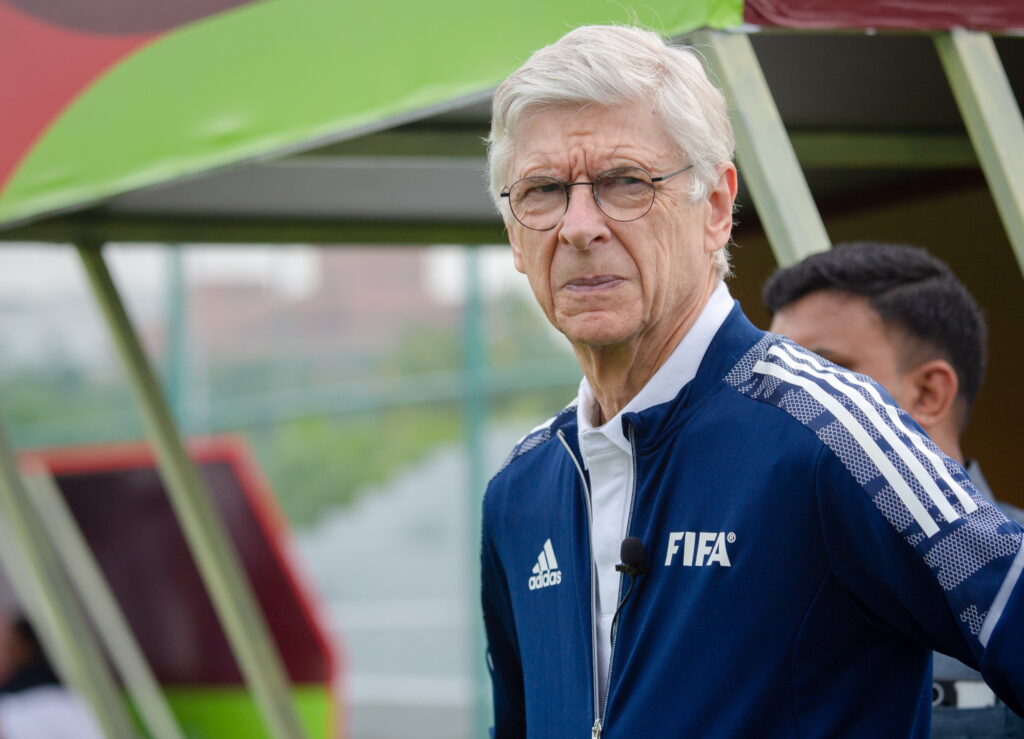
BAKU.Arsène Wenger says no country has an automatic right to greater football success than another, arguing that young players from smaller nations need opportunities to discover how they measure up against the best.
Speaking at the FIFA U-15 World Cup & Festival 2026 in Baku, Azerbaijan, FIFA’s Chief of Global Football Development said bringing countries of different footballing strengths together could help players recognise their potential and understand what they need to improve.
“I don’t believe that any country is entitled to have more success than [another], but number plays a part,” Wenger said.
“But we have seen many smaller countries, you know, competing with the bigger countries so that is important that they meet, and like I told you, they can compete.”
The event brings together players from 189 countries over one week, offering exposure that Wenger believes can change how young footballers view their own ability.
“When you compete, you basically discover, ‘Oh, I’m better than I thought. And if I do this [and] that, I can compete against the best.’ So that’s the opportunity,” he said.
“You want an opportunity to develop. When you say, ‘Give every talent a chance’, it’s about opportunity. Here they can come, play and discover that they have the needed quality to exist at the top level.”
That ambition also shaped the event’s playing format, Wenger explained that smaller-sided football and shorter matches were deliberate choices intended to make encounters between countries more useful.
“We wanted it to be a reduced number, not 11 against 11, because the difference between the countries would be too big,” he said.
“We wanted as well shorter games, you know, [so] that everybody can meet everybody. In life, when you love a sport, you want to know how good you are.”
For Wenger, those encounters should give teams more than memories. They should also provide a clearer assessment of their development needs.
“They can go home after, certainly full of dreams and of happy moments, but as well, they can know what they have to focus on to improve because they know where they stand.”
Eswatini talent coach Tomeu Perelló offered a practical explanation of how the format supports that development, pointing to the emphasis on getting players more involved in possession.
“Arsène [Wenger] is giving you [advice] and [is] telling you why the rules that we are playing in this tournament [are] to increase the touches of the player,” Perelló said.
“And this is for the better development [of] the players, and all of this is what we wanted.”
The learning opportunities extend to the coaches responsible for guiding those players after the event.
Amit Desai, a High-Performance Strategy Consultant, said bringing coaches together was an important part of the programme.
“Probably for many of them, [it’s] the first chance to really test themselves on a scale like this,” Desai said.
“For us, it was really important to bring those coaches together, to provide them also with some education, some developmental opportunities.”
Desai added that having Wenger involved offered coaches “some advice and guidance on how to develop their own skills”.
Vanuatu talent coach Álvaro López said access to Wenger and FIFA’s technical experts could influence both everyday coaching and longer-term player preparation.
“To be honest, having the chance to see Arsène [Wenger], specifically, and all of FIFA’s Technical Experts, who gave us advice and shared their perspective, which I think is really important.”
“How they see the player of the future and, as top professionals, where they think the sport might be heading is something very useful mainly for managing the day-to-day and the training sessions, but also for preparing and developing players,” López said.
Alongside the technical lessons, Wenger highlighted the value of young people from different backgrounds sharing the same environment.
“The players look so happy, so committed, and to see the whole world like that, united, communicating, dancing, playing, is just what football should do always.”
For the smaller nations, the next step is turning that exposure into progress at home, using the experience to shape training, address weaknesses and build on the potential their young players have shown.