

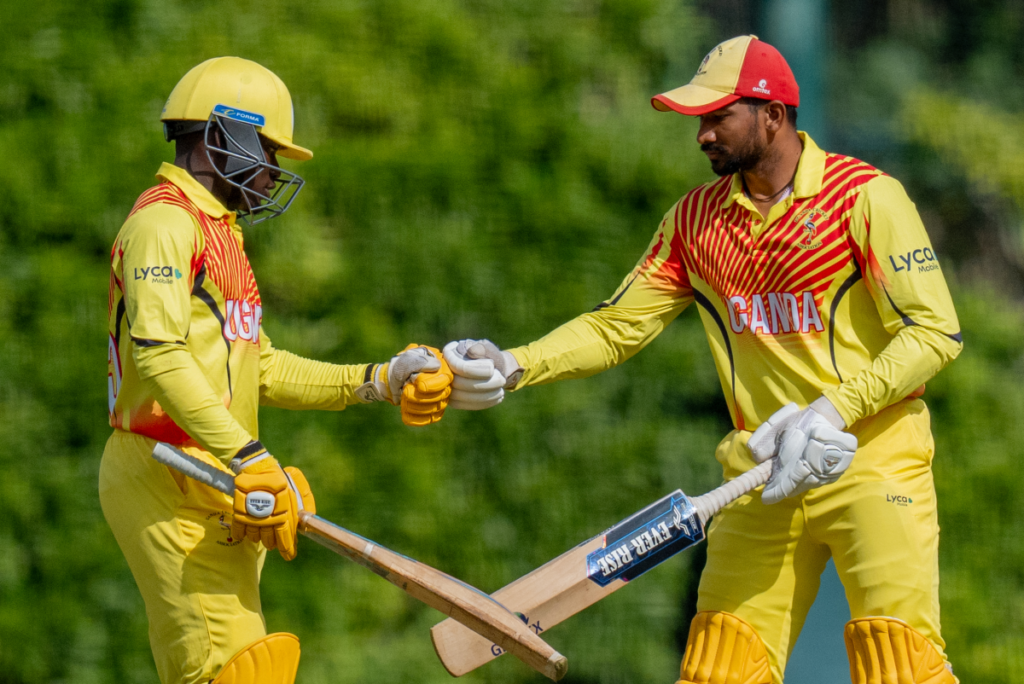
Uganda’s qualification for the ICC Cricket World Cup Qualifier Play-off has understandably been celebrated for what it means on the field, with the Cricket Cranes now guaranteed to play official One Day International cricket for the first time.
However, beyond the historic scorecards, rankings and ODI caps lies another opportunity that could prove just as important to the future of Ugandan cricket; improved funding, more international competition and a stronger platform on which Cricket Uganda can build the national game.
By finishing second behind Italy in the ICC Cricket World Cup Challenge League B, Uganda advanced to the eight-team Qualifier Play-off, where they will be joined by Italy, the top two teams from Challenge League A and the bottom four teams from Cricket World Cup League 2.
The ICC has confirmed that all matches at the Play-off will carry ODI status and that the tournament will produce the final four teams for the Cricket World Cup Qualifier.
For Uganda, however, there is an important distinction between playing ODIs at the Play-off and securing the right to play ODI cricket regularly over an entire international cycle.
Under the ICC’s classification regulations that took effect on July 1, 2026, the eight Associate countries currently holding men’s ODI status are Canada, Namibia, Nepal, Oman, Scotland, the Netherlands, United Arab Emirates and United States.
Their status is guaranteed until at least the conclusion of the 2027 Cricket World Cup Qualifier Play-off, while Uganda remains outside that group despite being guaranteed ODI matches at the coming tournament.
That explains why Uganda’s bigger ambition should be to climb from Challenge League cricket into the next League 2 cycle, where the Cricket Cranes would have access to a structured programme of regular 50-over international matches rather than relying mainly on qualification tournaments and specially arranged tours.
Canada provide perhaps the clearest example of what that transformation can mean. They came through the Challenge League in the previous World Cup cycle and earned their ODI status back at the 2023 Qualifier Play-off after finishing above fellow contenders Papua New Guinea and Jersey.
Their promotion into League 2 guaranteed them a considerably larger programme of international cricket for the following four-year cycle.
For Cricket Uganda, that sort of progress could have an important financial impact, although ODI status should not be mistaken for an automatic ICC cash prize. There is no published ICC formula stating that a country receives a fixed amount of money simply because it obtains ODI status.
Instead, Associate Member support is administered through the ICC Development Funding Model, which rewards members according to development and competition-related measures, including performance.
The ICC describes the system as merit-based, meaning stronger performance and progress across cricket development can contribute towards a member receiving greater support.
The overall financial pool is substantial. ICC audited accounts show that $47.481 million was paid to Associate Members in 2024, compared with $31.760 million in 2023.
That figure represents funding across the Associate membership rather than Uganda’s individual allocation, but it illustrates why improved sporting performance and positioning within the ICC structure matter financially.
For Uganda, the timing is particularly significant because Cricket Uganda is already operating under financial pressure.
At the federation’s AGM in March, Honorary Secretary Denis Musali acknowledged that international competitions and qualification campaigns were expensive and said Cricket Uganda was working within a “constrained budget”.
Those demands are easy to understand because international cricket requires expenditure on flights, accommodation, player allowances, coaches, preparation camps, medical support and practice matches before the first competitive ball is even bowled.
Cricket Uganda has consequently had to look beyond its own resources for ways of providing the Cricket Cranes with the preparation required to compete internationally.
The national team’s tour of Mumbai earlier this year provided one example. The Mumbai Cricket Association covered accommodation, match expenses and internal logistics as part of the developing relationship between the two organisations, significantly reducing the cost Cricket Uganda would otherwise have carried while still allowing the Cricket Cranes to gain valuable 50-over experience in India.
Promotion to League 2 would not suddenly remove those expenses, but it would give Uganda a more predictable international programme and allow Cricket Uganda to plan its high-performance spending around meaningful ICC competition.
It would also strengthen the federation’s position when approaching sponsors, because regular ODI cricket is a more attractive commercial product than occasional qualifiers whose international status and visibility vary from tournament to tournament.
There is also a domestic funding argument. A Cricket Cranes side playing regular ODIs and competing consistently against countries such as Namibia, Nepal, Scotland, the Netherlands and UAE would give Cricket Uganda a stronger case when seeking support from the National Council of Sports and government.
Additional resources could then be invested in areas that determine whether ODI status becomes sustainable, including player contracts, coaching, preparation tours, academy structures, women’s cricket, youth development and facilities.
That is where the financial importance of Uganda’s current journey becomes clearer, because success at senior international level can create opportunities that feed back into the wider development of the sport.
The next Qualifier Play-off could therefore become one of the most consequential tournaments Cricket Cranes have played. Uganda have already achieved one historic breakthrough because their first match at the competition will be an ODI, but the ambition has to extend beyond collecting Uganda’s first ODI caps.
The ICC has not yet publicly detailed how League 2 places and continuing ODI status will be allocated for the cycle after the 2027 Play-off, which means it would be misleading to claim that a particular finishing position will automatically bring Uganda a specific amount of money.
What is already clear, however, is that Uganda must continue climbing the 50-over structure if they want regular ODIs and the sporting and financial opportunities that accompany them.
For Cricket Cranes, therefore, the greatest prize is not simply having ODI written beside Uganda’s name.
It is reaching a level where international cricket becomes more regular, preparation becomes easier to plan, sponsors have a stronger product to support and Cricket Uganda has greater justification for attracting the resources required to develop the game.
That is why Uganda are playing for considerably more than history when they enter the Qualifier Play-off. They are playing for the opportunity to change the financial and competitive future of Ugandan cricket.