

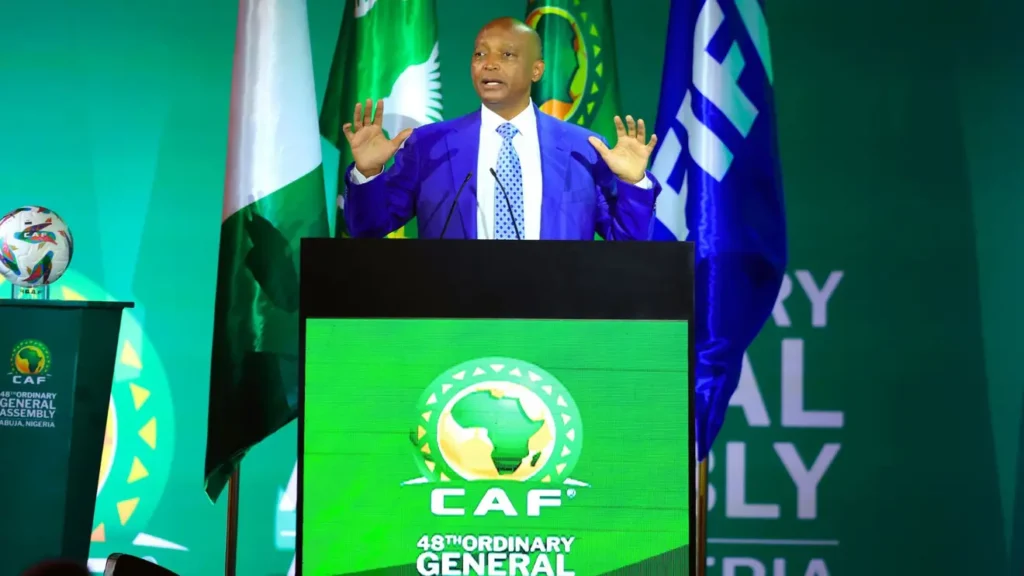
ABUJA. Five years after reporting debts of more than $100 million, African football’s governing body has rebuilt its reserves and raised annual funding for its 54 member associations.
The Confederation of African Football (CAF) reported a net profit of $31.2 million on revenue of $284 million for the financial year ended June 2026, as it increased the annual support available to national federations across the continent.
CAF presented the results at its 48th Ordinary General Assembly in Abuja, Nigeria, on Saturday.
The governing body ended the financial year with $118.8 million in cash, while its reserves moved from a deficit of $16.8 million to a positive balance of $14.4 million.
CAF attributed the improvement to a five-year turnaround strategy under president Patrice Motsepe. It said it was carrying more than $100 million in debt five years ago.
The return to positive reserves gives it a stronger financial base as it commits more money each year to national federations and regional unions.
What the higher funding means for federations
Each of CAF’s 54 member associations can now receive up to $700,000 a year, up from the previous ceiling of $525,000.
The increase took effect in July 2026 and follows a series of rises from the $200,000 annual allocation in 2021. CAF’s stated target is to provide $1 million per association each year.
CAF says the additional money is intended to help national federations invest in youth and women’s football, improve administration and create more opportunities for coaches and referees to develop.
In practice, that could mean running youth competitions more regularly or giving coaches and match officials more chances to train closer to home.
The increase extends to CAF’s six regional unions, whose annual allocations rose by 20 per cent, from $750,000 to $900,000 each.
The African Clubs Association’s allocation also increased from $400,000 to $500,000.
Ahead of the assembly, Motsepe met leaders of the national federations and regional unions in Abuja.
Their discussions covered how the associations could use the additional funding to grow the game while building programmes they can sustain over several seasons.
Schools football offers an example
One programme discussed in Abuja was the CAF African Schools Football Championship, federation presidents acknowledged a $10 million contribution from the Motsepe Foundation, which has supported prize money and projects to improve learning and sports facilities at schools.
The schools competition gives boys and girls a chance to compete beyond their domestic school calendars.
Its facility projects also show how investment linked to a tournament can benefit schools after the matches are over.