

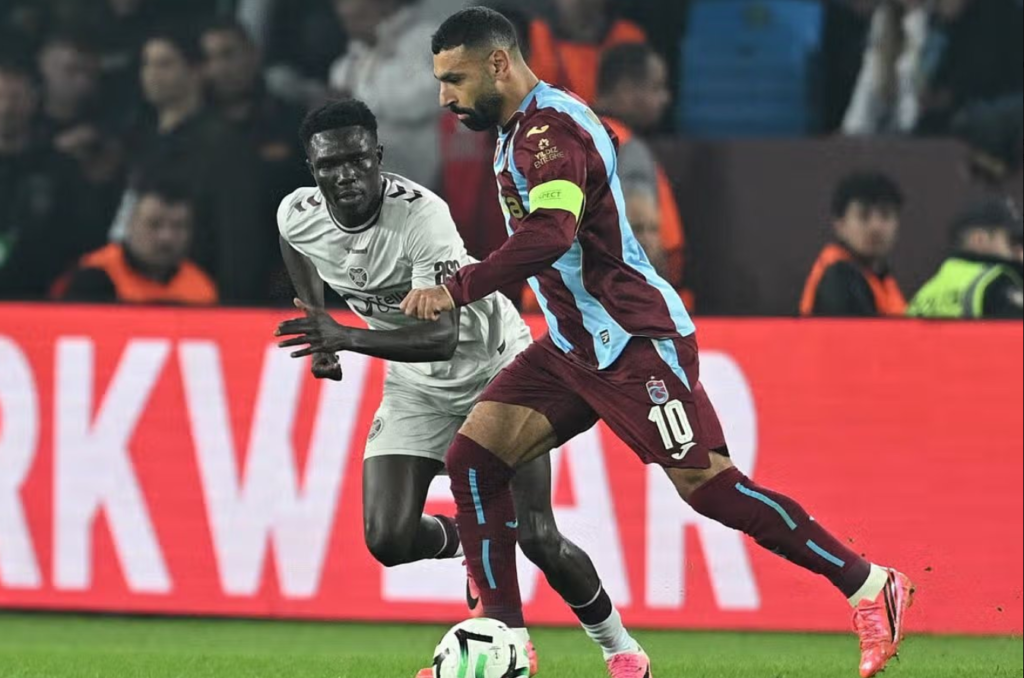
Rogers Mato is accustomed to troubling defenders with his pace and attacking instincts, but Thursday night presented an entirely different challenge for the Uganda Cranes international.
The predominantly attacking winger found himself playing at left-back for Scottish side Hearts against Turkish opponents Trabzonspor, facing an attack featuring Egyptian superstar Mohamed Salah.
Despite Hearts suffering a 2-0 defeat, Mato emerged as his team’s highest-rated player on Flashscore, earning a 7.3 rating after completing the entire 90 minutes.
His performance was particularly remarkable considering that the 23-year-old was operating outside his natural position against experienced international opposition.
How Mato ended up at left-back
Hearts manager Wouter Vrancken faced a defensive selection headache ahead of the European encounter after injuries depleted his available options.
Regular left-back Harry Milne suffered a serious knee injury during training, while Stuart Findlay, Oisin McEntee and Laurent Mendy were also unavailable.
The situation forced Vrancken to improvise, with Mato emerging as an unlikely solution to the club’s defensive problems.
Rather than deploying the Ugandan in his preferred attacking position, the Belgian tactician handed him responsibility for protecting Hearts’ left defensive channel.
It was a significant tactical adjustment for a player whose strengths have traditionally been associated with running at defenders and creating attacking opportunities.
Mato reportedly learned about the decision on matchday, leaving him little time to prepare for one of the toughest defensive assignments of his career.
The Ugandan had previously revealed that his last experience playing as a full-back came during his childhood in Uganda.
Mato’s numbers tell the story
Although Hearts struggled to contain Trabzonspor, Mato’s individual statistics demonstrated his commitment to an unfamiliar defensive responsibility.
According to Flashscore, he won six of his nine ground duels, representing a 67 percent success rate against the Turkish opposition.
He also registered five interceptions, 10 ball recoveries and two clearances, highlighting his involvement in breaking up opposition attacks.
The Ugandan completed three of his six attempted tackles and was dribbled past twice during the 90 minutes.
Beyond his defensive contribution, Mato remained involved in Hearts’ attempts to build possession and advance into attacking areas.
He recorded 63 touches and completed 28 of his 35 attempted passes, maintaining an accuracy rate of 80 percent.
His seven progressive carries illustrated his willingness to move forward with possession despite operating from a deeper position.
Mato also completed seven of his 10 passes into the attacking third, although neither of his two attempted crosses reached a teammate.
He attempted one shot, while his expected assists stood at 0.16, reflecting his occasional involvement in attacking situations.
Those contributions earned him a 7.3 Flashscore rating, making him Hearts’ highest-rated player despite the disappointing result.
A difficult assignment against Salah
Playing at left-back meant Mato had to contend with Salah, whose movement, acceleration and attacking intelligence have troubled some of Europe’s most established defenders.
The Egyptian was instrumental in Trabzonspor’s victory, scoring from the penalty spot before contributing to the second goal.
Salah opened the scoring in the 32nd minute before Franculino doubled the hosts’ advantage in the 58th minute.
Cameroon international André Onana also featured for Trabzonspor, keeping a clean sheet as Hearts struggled to find a breakthrough.
Although the result went against Hearts, Mato’s performance provided one of the few positives for the Scottish side.
His ability to compete defensively while maintaining involvement in possession demonstrated the versatility increasingly demanded of modern footballers.
What the performance means for Mato
For a player primarily recognised for his attacking qualities, Thursday’s performance offered another dimension to his development in Scottish football.
Mato has built his reputation through his pace, direct running and ability to operate across the forward line, qualities that have also made him an important option for the Uganda Cranes.
However, his display against Trabzonspor demonstrated that those attributes can also be useful in a defensive role.
His recovery speed, willingness to contest duels and ability to carry possession forward helped him adapt to the demands of playing at left-back.
With Hearts managing several defensive injuries, the Ugandan could find himself considered for similar assignments as the season progresses.
Nevertheless, his long-term value remains closely connected to the attacking qualities that established his reputation.
For Uganda Cranes coach Paul Put, Mato’s versatility could offer additional tactical flexibility, although his strongest attributes remain in advanced positions.
The defeat in Turkey was disappointing for Hearts, but Mato returned with an individual performance that underlined his adaptability.
Against a Trabzonspor side featuring Salah and Onana, the Ugandan demonstrated that even an unexpected defensive assignment could provide an opportunity to make his mark.